Offset printing on cardboard packaging for food products is both simple and difficult at the same time. Nevertheless, this is exactly what distinguishes our packaging from many others. It is difficult to explain to you what printing with a resolution of 2400 dpi is. You just need to compare what you had with what we offer.
Try it, everything will become clear immediately. It's not even about the brightness of the image, but about its realism. It is possible to obtain photographic quality only by offset or deep-cut printing. If you are tired of confirming the advantage of a product, let the beautiful, bright, lively packaging do it for you.
Until now, most of the milk packaging in Russia has been produced using flexo printing. At the same time, the image quality leaves much to be desired: only very simple, low-line or spot-shaped plots are clearly obtained. But even when printing packaging abroad, the lineature will not be very high: 150 lpi is a limit that is achievable only in some foreign printing houses and is used for the most expensive packaging. The result is jagged edges on smooth contours, and a large raster rosette that distorts the appearance of surfaces that are uniform in color. There are noticeable defects on the light-colored dies and on the edges of the dies. Small text is also not suitable for flexo printing. Getting a high–quality picture of a berry or fruit is a feat for flexo printing, and such feats are not performed either in Russia or in the near abroad.
For offset printing, the 150-175 lpi line is common. The thing is that flexography is essentially a type of high–definition printing in which the printed elements on the form are separated from the blank elements purely mechanically. Accordingly, in terms of the size of the printed elements, it will never compare with offset printing (which is sometimes called "flat"), in which the printed elements are chemically formed on the flat surface of the mold.The cost of forms or cliches for flexo printing is very high. So if you need to make any changes to the information on the package, place an advertisement, hold a prize draw or other promotion, then the cost of the forms, especially for small print runs, becomes very noticeable. In offset printing, the cost of the forms is an insignificant fraction of the cost of the print run, the customer does not even feel it. Also, the production time of flexoforms is much longer than that of offset forms. Accordingly, if at the last moment you decide to make changes to the design or text (you will agree, it is not such a rare case), it may turn out that you are late and you have to pay for new ones. When printing abroad, the time factor is compounded: the time zone there is completely different, and the approach to work.
One dairy plant can produce products of different price categories. If a product is positioned as more modern and enriched with vitamins, then it would be strange and illogical to use the same quality packaging for it as for the rest. On the contrary, it should stand out from the general background, including against the background of competing products from another manufacturer. The design and quality of packaging affect the success of product promotion no less, if not more, than expensive promotions in the media. So maybe it's worth spending money not on advertising, which many consumers already quietly hate, but on the real difference in the quality of packaging?
The advantages of offset printing make the impossible possible! Changing the design in one day with offset printing is a reality!
Imagine a situation: at the very last moment, you decided to make edits to the layout or design changes, such as inserting a greeting or promotional coupon, recipe, or any other text. All this can be done in one day! Believe me, we will spend much more time on coordination and phone conversations than on a real design change. Modern technologies such as computer-to-Plate and a team of professional designers and operators can do a lot and in the shortest possible time. Try it!
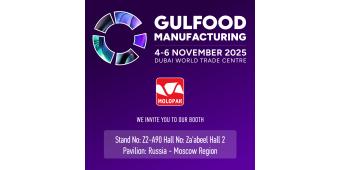
We invite you to the stand of the GulFood Manufacturing 2025 exhibition from November 4 to November 6 in Dubai.