Flexo printing occupies an honorable third place among popular printing technologies, second only to offset and digital printing. Its popularity is due to a combination of relative simplicity, low cost, and high production speed. The flexo printing process, in its most simplified form, can be represented as applying an image from a flexible cliche (flexoform) to the material being sealed.
However, this apparent simplicity hides a rather complex and interesting technology that covers many aspects, from the choice of materials to the subtleties of equipment configuration.
Flexography is a type of high–pressure printing, which means that the printing plate rises above the surface to be sealed. Unlike gravure printing, where ink fills in the indentations on the cliche, in flexography, ink is applied to the towering flexoform elements, which then transfer the image to the material.
Flexible photopolymer plates, flexoforms, are used as printing plates. They are produced by photopolymerization, where, under the influence of ultraviolet light, the photopolymer material solidifies in accordance with the created image.
This process allows you to create flexoforms with high precision and detail, capable of reproducing even the smallest design elements, such as fine lines, small fonts or complex bitmaps. The blank elements of the flexoform remain unsealed, which guarantees high purity and clarity of the print.
The flexoform manufacturing process itself includes several steps: creating a film with an image, exposing a photopolymer plate, washing and subsequent processing to increase wear resistance. The quality and durability of the flexoform directly affects the print quality and overall process performance.
The printing process itself begins with the installation of a flexoform on a printing cylinder. The paint, usually water–based, is applied to the flexoform using an anilox shaft, a special shaft with cells of a certain depth and geometry that ensure uniform application of paint to the flexoform surface. Then the paint is transferred from the flexoform to the sealed material, which is pressed against it by a counterpressure cylinder. Adjusting the pressure and speed of rotation of the cylinders allows you to control the thickness of the ink layer and print quality. To achieve the best results, a precise ink supply control system is used, which guarantees color stability and image density throughout the entire print run. Modern flexographic machines are equipped with automated monitoring and control systems to minimize defects and increase work efficiency.
The advantages of flexo printing are numerous:
However, flexography is not without its drawbacks. Prepress preparation, although not as difficult as in offset, still requires time and professional skills. The print quality largely depends on the operator's skills and the correct configuration of the equipment. In addition, achieving high color accuracy may require additional effort and calibration.
When printing bitmap images, which are more complex in structure and require high quality, offset printing is more often chosen.
In conclusion, flexography is a powerful and versatile printing technology that continues to evolve and improve. The combination of speed, economy, environmental friendliness and flexibility makes it indispensable for many industries, especially in the field of packaging and label production.
The continuous development of materials and equipment promises to further expand flexography's capabilities and strengthen its position in the print market.
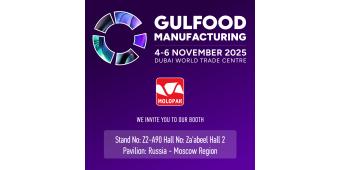
We invite you to the stand of the GulFood Manufacturing 2025 exhibition from November 4 to November 6 in Dubai.